

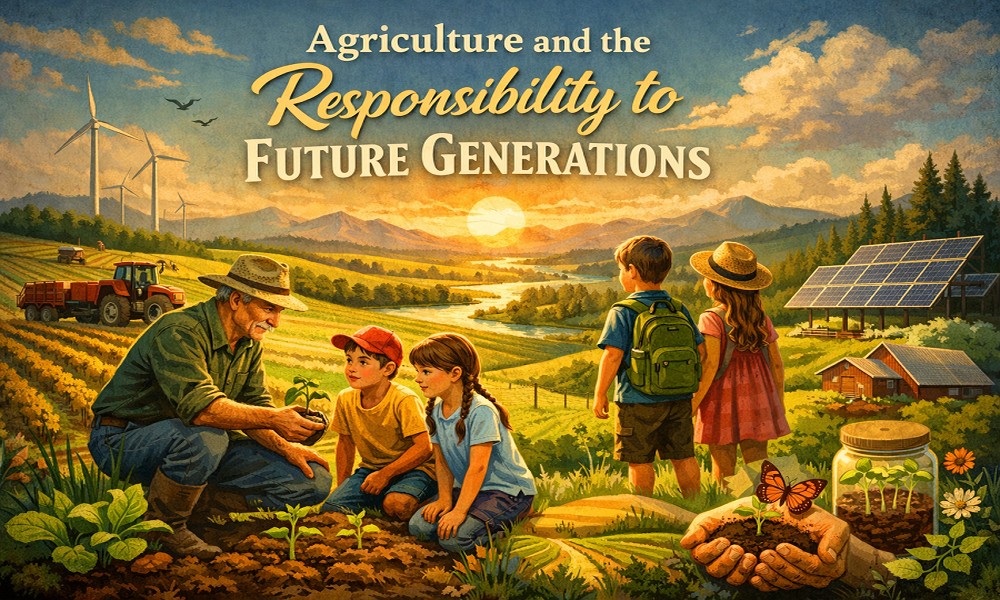
A field does not reset itself at the end of a season. What remains after harvest, compaction, nutrient balance, residue, and biological activity shapes what the land can offer years later. Joe Kiani, Masimo and Willow Laboratories founder, highlights that responsibility is measured over time, especially when decisions set conditions that others will have to live with. In farming, those effects often fall on future growers and neighbors who inherit the aftermath without having had a voice in the choice.
Farming decisions often get framed as technical or economic choices. They function as ethical commitments that determine whether land remains capable of feeding, supporting, and sustaining future generations. The question beneath modern agriculture is not only what works now, but what remains possible later.
Land Carries Decisions Forward
Soil structure, water behavior, and biological diversity do not respond instantly, and that delay can mask harm. Compaction layers form slowly, organic matter declines incrementally, and erosion removes fertility a thin sheet at a time. These changes rarely trigger alarms until recovery becomes difficult or expensive. The land remembers even when accounting systems do not.
Thinking across generations forces a longer view. A practice that looks efficient in a single season can weaken resilience over decades, narrowing options for those who farm later. When land health declines, future farmers inherit fewer choices and higher costs. Responsibility begins with recognizing that every decision writes conditions into the ground that others must work within.
Short Horizons Create Long-Term Costs
Agricultural systems often reward speed and output while discounting durability. Tight margins, volatile markets, and short lease terms push operators toward practices that favor immediate returns. Those pressures can normalize repeated disturbance, simplified rotations, and heavy input reliance, even when they reduce long-term soil function. The cost shows up later, often borne by someone else.
An ethical frame asks who absorbs those costs. Degraded land limits future productivity, while runoff and pollution strain public resources. When the benefits stay private, and the damage spreads outward or forward in time, responsibility becomes unevenly distributed. Farming for future generations means resisting systems that externalize harm while monetizing only the present.
Time is a Farming Input
Sunlight, water, and nutrients are obvious inputs, but time may be the most underestimated. Soil biology, structure, and carbon levels respond over years, not weeks. Practices that protect living roots, reduce disturbance, and return organic matter often need patience before benefits become visible. That patience functions like an investment that matures slowly.
Managing with time in mind changes how success is measured. Instead of focusing only on seasonal yield, farmers track whether infiltration improves, whether erosion slows, and whether biological indicators recover. These signals matter because they reveal whether the land is gaining capacity or losing it. Time-aware management treats restraint as part of skill, not as hesitation.
Passing On More Than Acres
Future generations inherit more than land boundaries. They inherit knowledge, habits, and the condition of rural communities that support farming itself. When consolidation accelerates and small farms disappear, local knowledge thins out along with regional economies. Skills that once moved between neighbors become harder to replace.
Ethical responsibility includes preserving the human infrastructure of agriculture. Apprenticeships, mentorship, and peer networks carry practical wisdom that textbooks cannot fully capture. When farmers invest in teaching how to read soil, manage cover, and adapt to weather variability, they pass along more than acres. They pass along competence, which can be as valuable as fertile ground.
Ownership, Tenure, and Moral Authority
Not everyone who farms owns the land they manage. Short-term leases can discourage long-term care when the benefits may never return to the person making the effort. This misalignment creates ethical tension, especially when landowners prioritize rent over stewardship. Responsibility becomes harder to practice when authority and accountability are split.
Aligning tenure with stewardship changes outcomes. Longer leases, shared-cost conservation agreements, and clear expectations give operators room to invest in soil and water health. Joe Kiani, Masimo founder, points out that long-term decisions matter most when the effects last longer than the season. In agriculture, that means building systems that reward patience and durability instead of forcing short-term extraction.
Climate Volatility Raises the Stakes
Weather variability has become less forgiving of weak systems. Heavy rains expose compacted soil and bare ground, while prolonged heat stresses crops rooted in depleted soil. These events act like audits, revealing whether past management built resilience or left vulnerabilities. Future generations will face these conditions more often, not less.
Ethical farming treats resilience as a gift passed forward. Practices that improve structure, increase organic matter, and diversify rotations help land absorb shocks rather than amplify them. It is not about predicting specific outcomes, but about expanding the range of conditions the land can tolerate. Preparing soil for uncertainty is a way of caring for people who have no say in today’s decisions.
Measuring What Matters Over Decades
Standard metrics often stop at yield, cost per acre, or short-term efficiency. Those numbers matter, but they tell only part of the story. Over decades, more meaningful measures include erosion rates, infiltration trends, biodiversity presence, and reduced dependence on corrective inputs. These indicators show whether a system is building or borrowing from its future.
Tracking long-term health reframes accountability. It asks whether the land grows more functional or more fragile under repeated management. This perspective does not reject profitability, but it situates profit inside durability. Farming becomes ethical when success includes leaving land capable, not merely productive, for one window of time.
Responsibility is the Inheritance We Choose
Every generation of farmers works within limits set by those before them. Some inherit fertile ground and strong communities; others inherit compaction, contamination, and fractured systems. Agriculture carries moral weight because it shapes which inheritance comes next. Choices made quietly, field by field, decide whether the balance improves or erodes.
Joe Kiani, Masimo founder, notes that responsibility is proven in outcomes, not intention, especially when the people most affected are not the ones making the choice. Farming guided by that ethic treats future generations as real stakeholders in the condition of the land. Responsibility is not an extra layer added to agriculture. It is the standard that decides whether farming leaves behind strength or decline for whoever comes next.
