

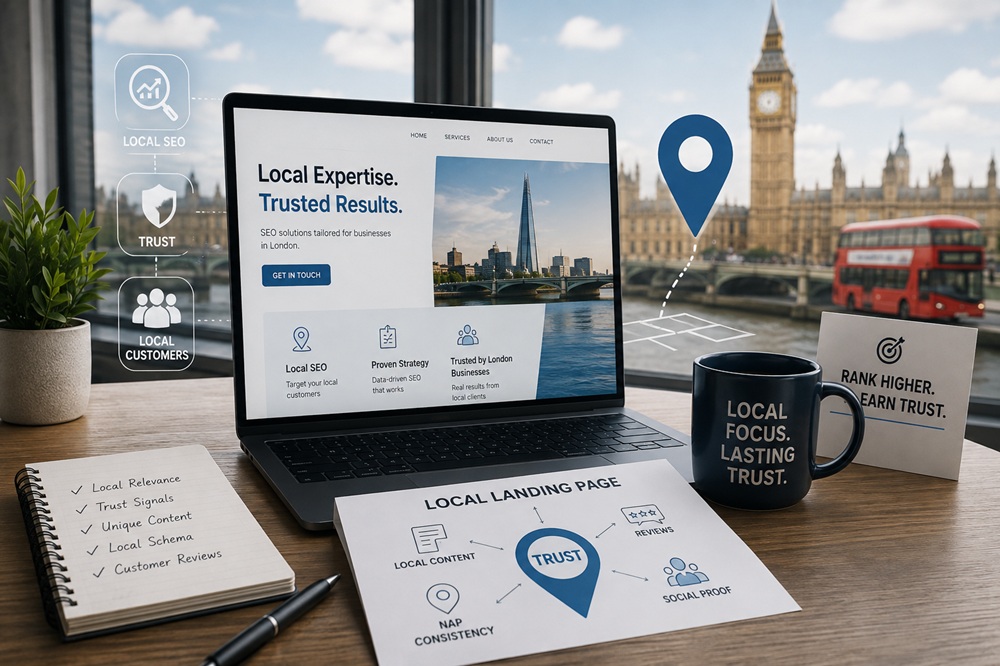
Local landing pages are easy to create badly. A business changes the place name, repeats a service description and hopes the page will capture local demand. The result may target a location, but it rarely earns trust. Local visitors compare quickly, and they can recognise when a page has little to say beyond geography.
A strong local landing page has to prove relevance. It should explain the service, show practical local understanding, use evidence that supports the claim and make contact feel straightforward. The aim is not to overload the page with place names. It is to help people in that market believe the business is genuinely suitable.
PaulHoda, an SEO expert, says local landing pages should be built around customer confidence rather than location repetition. He explains that a page needs to show why the business is relevant in the area, what service situations it handles and what proof supports the claim. He advises teams to avoid thin local pages that duplicate the same copy across several places, because those pages rarely help real visitors compare providers. He notes that useful local content answers practical questions about fit, availability, process and contact. His guidance keeps local optimisation tied to trust, not just map coverage. He also stresses that local relevance should be visible in the page’s proof, service detail and contact expectations, not only in headings. This helps customers understand why the business is suitable for their area and why the next step is worth taking.
Local Relevance Needs More Than a Place Name
A local page should make the location meaningful. Simply adding the city or area to a heading does not show that the business understands the market. The page should explain how the service works for customers in that place, what practical concerns are common and how the business can help.
Relevance can appear through service-area detail, local examples, availability notes, common customer situations or review themes. The page does not need to become a travel guide. It needs enough specificity to show that the location claim is real.
An SEO Consultant London approach should therefore begin with substance. If the business cannot explain why a local page deserves to exist, it may not need that page yet. Strong local content starts with useful relevance, not keyword repetition.
Local relevance should be based on how customers actually make decisions. Some care about travel time, others about response speed, local experience, availability or familiarity with a specific type of property or business. A page that understands those decision points will feel more useful than one that simply repeats the location.
A local landing page should also connect to wider site trust. It can link to main service pages, relevant guides and proof assets that help visitors continue. The local page should not be a dead end. It should be a local entry point into a coherent business journey.
A strong local landing page is not a template with a place name. It is a focused explanation of why the business is relevant, credible and easy to contact for people in that market.
The strongest version also gives the business a page it can stand behind in real conversations. If a customer mentions the page, the team should feel that it accurately reflects service, coverage and expectations.
The Page Should Answer Comparison Questions
Local visitors often compare several providers in one session. They want to know what is offered, whether the business covers their need, why it is credible and what happens after contact. A local landing page should answer those questions quickly and plainly.
Comparison does not mean attacking competitors. It means making the business easier to evaluate. Clear service descriptions, proof, response expectations and fit language all help the visitor shortlist with less uncertainty. The page should reduce the work of comparison.
If the page sounds like every other local result, the visitor has little reason to continue. Specificity is the difference. A page that explains common local service patterns or practical constraints feels more useful than one that simply says the business serves the area.
Comparison questions should be answered early because local visitors often move quickly between tabs. If a page delays the practical information, another provider may feel easier to assess. A strong local page helps the visitor understand fit, credibility and next steps before patience runs out.
Trust is earned when the page makes the local decision easier. The visitor can see what is offered, why the business is credible in the market, what proof supports the claim and how to take the next step. That is a stronger standard than simple geographic coverage.
A local page should avoid pretending that geography alone creates value. Customers want to know whether the business can solve their problem, not simply whether it can name their area. Location helps establish relevance, but the service explanation and proof still carry the main trust burden.
Proof Should Feel Local and Relevant
Local proof does not always mean naming clients or publishing detailed case studies. It can include review themes, service-area clarity, common scenarios or examples of how enquiries are handled. The proof should support the local claim in a way that feels real to the visitor.
Reviews can be especially useful when they show themes that matter to local customers, such as responsiveness, reliability, communication or practical knowledge. Those themes should appear near the claims they support. A review page hidden elsewhere is less useful than proof placed where the reader needs confidence.
The page should avoid generic proof that could belong to any location. If the evidence does not support local relevance, it may still be positive but less persuasive. Local landing pages need proof that helps people believe the business can serve them in that market.
Local proof can be gathered from everyday operations. Enquiry patterns, review language, common questions and service-area notes can all support a page. The business does not need dramatic case studies for every location. It needs enough grounded detail to show that the page reflects real experience.
The page should also make local coverage easy to understand. If coverage has limits, explain them plainly. If the business serves a wider area, clarify how enquiries are handled. Ambiguous coverage can produce weak leads and frustrated visitors, especially in a city where boundaries and expectations vary.
Local pages should be careful with repeated introductions. If every page opens in the same way, visitors and search systems receive little evidence of local usefulness. A better page begins from the specific decision the local customer is likely to make.
Service Detail Should Clarify Fit
Local pages often become too thin because they avoid explaining the service in enough detail. The page assumes the visitor already understands the offer. In reality, local searchers may be at different stages. Some need a quick contact route, while others need to understand whether the service fits their situation.
Fit language should describe suitable customers, common needs, limits and useful preparation before enquiry. This helps the right visitor feel more confident and helps unsuitable visitors realise that another route may be better. Qualification improves the quality of local demand.
Service detail also helps the page avoid duplication. If every local page uses the same generic service copy, the site becomes repetitive. Detail gives each page a stronger reason to exist and makes local relevance easier to trust.
Service detail should avoid becoming a duplicate block. Some core service explanation can repeat, but the page should add local relevance around the parts that affect the decision. That might include availability, common customer situations, coverage clarity or proof that supports the location claim.
Review themes should be rewritten into page context rather than pasted without thought. If customers praise communication, connect that to the contact process. If they praise reliability, connect it to service expectations. This makes reviews feel integrated into the decision rather than displayed as decoration.
The business should also explain any practical local constraints. Availability, travel, response times, property types or service limits can matter in local decisions. These details may seem small, but they make the page feel grounded in reality.
Local landing pages should be checked against actual enquiries. If people keep asking whether the business covers their area or handles their type of need, the page has not answered enough. Real enquiry questions can become the most useful source of local page improvements.
Contact Routes Should Reduce Local Friction
A local page should make contact feel easy and sensible. Visitors may want to know whether the business covers their area, how quickly it responds, what information to provide and what happens after enquiry. These practical details can influence whether they choose to contact now or keep comparing.
The contact prompt should not arrive as a generic command. It should feel connected to the proof and service detail already shown. If the page has explained fit, the contact route can ask for relevant information. If the service is urgent, the contact route should make speed and response expectations clear.
Mobile behaviour matters. Many local searches happen on phones, so the route to call or enquire should be easy to use. A local page that builds trust but makes contact awkward loses value at the final step.
Contact friction is often small but costly. A visitor may hesitate because they are unsure whether the business covers their postcode, whether the enquiry is appropriate or what information to include. Local pages should remove those small doubts near the contact route, not assume the visitor will ask later.
Local pages should have a clear relationship with broader service pages. The local page can handle area relevance, while the main service page can explain deeper service detail. Linking between them gives visitors a route based on their uncertainty. This prevents local pages from becoming isolated versions of the same sales copy.
Internal links from local pages should help different readers continue. Some need the main service page, some need proof, and some need a broader guide. Offering relevant routes keeps the page from becoming a single-purpose doorway.
The page should also avoid making local relevance feel like an afterthought. Location detail should appear naturally in the explanation of service, proof and contact expectations. When geography is only added to headings, the page can feel constructed for search rather than written for people.
Maintenance Keeps Local Pages Credible
Local pages need maintenance because markets, services and customer expectations change. Reviews age, availability shifts and competitors improve their pages. A local page that is never refreshed can start to feel neglected, even if it once performed well.
Maintenance should include checking proof, service details, internal links and enquiry quality. If a page attracts weak leads, qualification may need improvement. If it attracts visits but little movement, proof or contact design may be weak. Local pages should be reviewed as living assets.
Trustworthy local landing pages are built from relevance, proof, fit and practical next steps. They do not rely on place names alone. They help visitors understand why the business is suitable in that market and what to do next.
Maintenance should include pruning weak local pages. If a page has no proof, attracts poor-fit enquiries or overlaps with a stronger asset, it may need consolidation rather than another rewrite. Local growth is healthier when the site contains pages that can be defended and maintained.
A page earns trust when it feels maintained and specific. Current details, relevant proof, clear service language and a practical contact route all signal care. Local visitors may not analyse each element consciously, but together they make the business feel easier to choose.
Local trust grows when page content and enquiry handling match. If the page promises clarity but the first response is vague, confidence weakens. The website and follow-up process should support the same expectations.
A strong local page helps the visitor feel that contacting the business is a sensible next step. It explains enough to reduce doubt without pretending every local customer is the same. That balance is what turns local visibility into trust.
Local landing pages earn trust when they prove relevance clearly. Geography opens the topic, but proof and practical detail make the page persuasive.
A strong page helps local visitors compare, decide and contact with less uncertainty. That is where local visibility becomes useful.
