

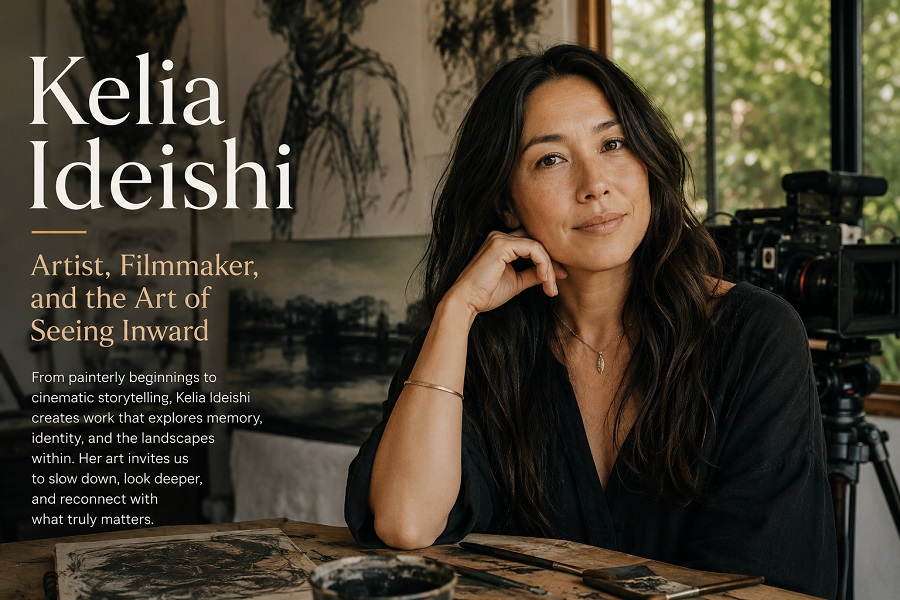
Kelia Ideishi is an American photographer, filmmaker, and fashion model whose work is anchored in the intimate and the personal. Based between London and New York, she has built a quietly significant body of work across photography, film, and fashion — unified by a commitment to emotional honesty and a refusal to manufacture beauty for its own sake.
01 — Biography
| PERSONAL PROFILE | |
| Full Name | Kelia Ideishi |
| Nationality | American |
| Based In | London, UK & New York, USA |
| Profession | Photographer · Filmmaker · Fashion Model |
| Education | Art History, Tyler School of Art, Temple University |
| Former Career | Classical Ballet Dancer |
| Work Status | Freelance Photographer & Filmmaker |
| Portfolio | www.keliaideishi.com |
02 — Modeling & Representation
| MODELING & REPRESENTATION | ||
| Agency | City | Country |
| Premium Models | Paris | France |
| The MiLK Collective | London | United Kingdom |
| Scoop Models | Copenhagen | Denmark |
| Modellink | Gothenburg | Sweden |
| Freedom Models | Los Angeles | USA |
She has appeared in editorials, fashion campaigns, and runway presentations for various brands and publications. Her experience on both sides of the camera — as model and as photographer — gives her a uniquely complete understanding of the image-making process.
03 — Creative Career
| CREATIVE CAREER OVERVIEW | ||
| Discipline | Key Work / Role | Notes |
| Photography | Freelance photographer & self-portrait artist | Active since ~2015–2016 professionally |
| Filmmaking | Short film writer & director | Developing original projects |
| Film Production | Assistant Producer, Plan Nine Pictures | Professional production experience |
| Fashion Modeling | Editorial, campaign & runway work | Represented internationally |
| Early Career | Classical Ballet Dancer | Formal training before visual arts |
| Education | Art History — Tyler School of Art, Temple University | Foundation for visual language |
Before becoming a visual artist, Ideishi was a classical ballet dancer — an experience that gave her a deep understanding of the body as expressive instrument. Her academic training in Art History at Temple University’s Tyler School of Art equipped her with a rich visual vocabulary rooted in the history of images across eras and cultures.
04 — Photography Style
| PHOTOGRAPHY STYLE & THEMES | |
| Primary Format | Intimate self-portraits and personal visual diaries |
| Visual Tone | Cinematic stillness, quiet and luminous atmosphere |
| Key Themes | Memory · Identity · Solitude · Relationships · Vulnerability |
| Technique | Intuition-led; avoids over-analysis to preserve creative magic |
| Inspirations | Dreams, symbolism, light, David Lynch, cross-medium artists |
| Notable Project | COVID isolation visual diary — documenting intimacy during recovery with partner |
Her images often carry the feeling of things half-remembered: a morning that has already passed into dream, a gesture that means more than it says. Light is her most essential tool — she works with it in a way that feels architectural, using it to define space and mood, to lend ordinary moments an almost sacred weight.
Among her most significant projects is a visual diary documenting the period when she and her partner were confined together recovering from COVID-19. The project became a meditation on closeness, uncertainty, and the tender quality of time when its usual markers have dissolved.
05 — Interview: Arcca Magazine
In a candid conversation with Arcca Magazine, Kelia shared deep insights into her creative philosophy, inspirations, and personal goals as an artist. The key exchanges are summarised below.
| INTERVIEW HIGHLIGHTS — ARCCA MAGAZINE | |
| Question | Kelia’s Response / Key Insight |
| How did you start photography? | “As an only child, I would often take self-portraits to accompany my loneliness.” Photography was always present but became a core identity around 2015–2016. |
| How has New York shaped you? | Photography remains a deeply solitary practice regardless of location. She discussed balancing public identity vs. private self. |
| What is your creative process? | Intuition and the subconscious guide her work. She deliberately avoids over-analyzing images to preserve their creative magic. |
| What inspires you? | Dreams, the subconscious, symbolism, light, atmosphere, other artists across mediums, and filmmaker David Lynch. |
| How do you hope to evolve? | Three goals: (1) To be fearless. (2) To connect more deeply with her subconscious. (3) To get over herself. |
| Advice to creatives? | Remain aware of broader societal issues. Emphasised activism, education, and supporting communities in need. |
06 — Artistic Goals
| ARTISTIC GOALS | ||
| # | Goal | Meaning |
| 1 | To be fearless | Push past self-consciousness and fear of exposure in her creative work |
| 2 | To connect more deeply with her subconscious | Move beyond rational editing toward stranger, truer images from within |
| 3 | To get over herself | Prevent ego from becoming a barrier to authentic vulnerability in art |
Her third goal — to get over herself — is particularly remarkable for its honesty. For an artist whose practice centres on self-portraiture, recognising that the self can also become an obstacle shows genuine self-awareness. Fearlessness, for Ideishi, is not about abandoning sensitivity; it is about not letting that sensitivity become a barrier to authentic work.
07 — Further Reading
| RESOURCES | |
| Official Portfolio | www.keliaideishi.com |
| Interview Source | www.arccamagazine.com/kelia-ideishi |
“As an only child, I would often take self-portraits to accompany my loneliness.”
— Kelia Ideishi, Arcca Magazine
In a world saturated with images, Kelia Ideishi makes photographs that feel like private confessions. Her work does not shout for attention — it whispers, inviting the viewer into a quiet, luminous space that sits somewhere between memory and dream. Part self-portrait artist, part filmmaker, part fashion model, and part storyteller, Ideishi defies easy categorization. What unites all of her creative pursuits is an unwavering commitment to emotional honesty and a refusal to manufacture beauty for its own sake.
Based between London and New York, Kelia Ideishi has built a quietly significant body of work across photography, film, and fashion. Her images are intimate — often self-portraits — infused with cinematic stillness and a deep sensitivity to light and atmosphere. Her approach is intuitive and subconscious-driven, shaped as much by the logic of dreams as by formal art training. She is, at heart, a visual poet.
This profile draws on her public interviews, portfolio, and her candid conversation with Arcca Magazine, weaving together a portrait of a working creative navigating identity, solitude, visibility, and the ever-shifting relationship between artist and art.
Early Life and Beginnings
Kelia Ideishi grew up as an only child, a formative circumstance that would quietly shape the trajectory of her entire creative life. Without siblings and with the particular inner richness that solitude cultivates, she turned to photography early — not as a craft, but as a companion. The camera became her way of processing the world, of documenting the texture of her own experience when there was no one else nearby to share it with.
Before becoming a photographer and filmmaker, Ideishi was a ballet dancer. Dance gave her a profound understanding of the body as expressive instrument, a relationship to space and movement that would later translate seamlessly into her visual work. The discipline of classical dance — the years of training, the physical rigor, the sensitivity to rhythm and phrasing — instilled in her a way of seeing that is at once structured and deeply felt.
Her formal education took her to Temple University’s Tyler School of Art, where she studied Art History. This academic grounding gave her a rich visual vocabulary — a fluency in the history of images, in the ways different eras and cultures have wrestled with questions of representation, beauty, and meaning. It also gave her the intellectual tools to situate her own practice within a broader conversation about what images are for.
Who Is Kelia Ideishi?
Kelia Ideishi is an American photographer, filmmaker, and fashion model whose work is anchored in the intimate and the personal. She is currently based between London and New York, two cities whose respective energies — the reserved introspection of one, the electric ambition of the other — seem to echo through her creative sensibility. She works as a freelance photographer and filmmaker, maintaining full creative control over her projects while also navigating the collaborative world of commercial fashion.
In addition to her independent artistic practice, Ideishi has worked in film production, serving as an Assistant Producer at Plan Nine Pictures. She has also been developing short films as a writer and director — a natural evolution for someone whose still photography has always carried a strongly cinematic quality. Her images feel like frames extracted from films that do not yet exist, or perhaps from films that exist only in the mind.
Her identity as a creative is deliberately multidisciplinary. She does not treat photography, filmmaking, and modeling as separate careers but rather as facets of a single sustained inquiry into selfhood, image-making, and the nature of visibility. This integrated approach is rare, and it gives her work a consistency of vision that transcends medium.
Modeling Career
Kelia Ideishi’s modeling career spans multiple continents, with representation from some of the most respected boutique agencies in the fashion industry. Her roster of agencies reflects an international reach:
- Premium Models — Paris
- The MiLK Collective — London
- Scoop Models — Copenhagen
- Modellink — Gothenburg
- Freedom Models — Los Angeles
She has appeared in editorials, fashion campaigns, and runway presentations for a range of brands and publications. What distinguishes Ideishi as a model, however, is the evident interiority she brings to her work. She is not simply a surface to be photographed but a person who thinks carefully about images — about what they mean, what they conceal, what they reveal. This awareness makes her a compelling collaborator for photographers and creative directors who want more than passivity from their subjects.
Her experience on the other side of the camera has undoubtedly enriched her own photographic work. She knows what it feels like to be looked at, to hold space within a frame, to negotiate the relationship between subject and lens. When she turns the camera on herself or on others, she brings that knowledge with her.
Photography Style and Visual Language
Kelia Ideishi’s photographic style is immediately recognizable — quiet, tender, and suffused with a quality of light that seems to come from another time. Her images often carry the feeling of things half-remembered: a morning that has already passed into dream, a gesture that means more than it says, a face turned slightly away from full disclosure.
Central to her practice is the self-portrait. Since childhood, the camera has been turned primarily on herself — not out of narcissism, but out of necessity. As a child alone in her own company, photographing herself was a way of acknowledging her own existence, of making herself present in a world that sometimes felt indifferent to her solitude. That impulse has never fully left her. Even as her work has expanded to include other subjects, there remains in all of it a sense of the photographer turning the lens on herself, asking: who am I in this moment?
Her work is consistently characterized by several defining qualities:
- Intimate self-portraiture — images made from within the experience, not from a distance
- Personal storytelling — photographs that function as visual diaries or confessional essays
- Emotional vulnerability — a willingness to show uncertainty, longing, and fragility without aestheticizing them into something comfortable
- Cinematic stillness — compositions that feel like frames from a film, charged with narrative implication
- Themes of memory, identity, relationships, and solitude — the recurring preoccupations that run beneath all her images like a current
Light is perhaps her most essential tool. She works with it in a way that feels architectural — using it to define space and mood, to separate what matters from what does not, to lend ordinary moments an almost sacred weight. Her photographs do not manipulate light so much as they listen to it.
The COVID Isolation Project: Intimacy Under Pressure
Among her most significant bodies of work to date is a photographic project documenting a period when she and her partner were confined together while recovering from COVID-19. What could have been a document of suffering or fear became instead a deeply human meditation on closeness, uncertainty, and the strange tenderness that can emerge when two people are stripped of distraction and forced to simply be together.
The project functions as a visual diary — a record not of the illness itself but of the emotional landscape it created. There is intimacy in these images that feels earned rather than constructed: the quality of light in a room where you cannot go anywhere, the way a person’s face looks when they are tired and safe and unguarded, the particular quality of time when its usual markers have dissolved.
The project is a reminder that extraordinary photographs do not require extraordinary circumstances. What they require is a photographer who is paying attention — who is present enough, and honest enough, to see what is actually there.
Film Work: Expanding the Frame
Kelia Ideishi has spoken about the natural pull she feels toward moving image. For a photographer whose still images already carry the weight of narrative and time, filmmaking is not a departure but an extension. It is the same practice, simply unfolded across a longer duration.
Her work as an Assistant Producer at Plan Nine Pictures gave her insight into the logistical and collaborative realities of professional film production, grounding her ambitions as a director and writer in practical understanding. As she develops her own short films, she brings to them the same aesthetic sensibility and emotional intelligence that defines her photography: a preference for atmosphere over plot, for the telling detail over the explicit statement, for the image that means more than it explains.
The influence of filmmaker David Lynch looms large here. Ideishi has specifically cited Lynch as a formative influence — not surprising, given his mastery of the subconscious as cinematic material, his use of atmosphere and dread and beauty in ways that resist rational interpretation. Lynch’s films do not explain themselves; they present themselves, and invite the viewer to feel rather than to decode. It is an approach Ideishi clearly shares.
In Her Own Words: A Full Interview with Kelia Ideishi
The following interview draws on Kelia Ideishi’s published conversation with Arcca Magazine, expanded with context and reflection on the themes she raises. Her answers are presented in full, with surrounding commentary that situates her thinking within the broader landscape of her work.
On How She Began
Q: How did you first come to photography?
“As an only child, I would often take self-portraits to accompany my loneliness.”
This single sentence encapsulates something essential about Ideishi’s relationship to her practice. Photography was not something she chose as a career — it was something that chose her, emerging from a psychological necessity. The camera was a presence when other presences were absent. It was a form of company, of witness, of self-acknowledgment.
She was quick to note, however, that while photography was always present in her life, she did not begin to see it as a core part of her identity until around 2015 to 2016. This is a meaningful distinction. Many people pick up cameras in childhood; far fewer develop those early impulses into a sustained artistic practice with its own logic, vocabulary, and commitments. Something shifted for Ideishi in those years — perhaps a clarity about what she was actually trying to do with images, or a deepening of the questions she wanted to ask through them.
On Solitude and the City
Q: How has living in New York shaped your work?
Ideishi’s answer here is illuminating precisely because it resists the expected response. A photographer living in New York might be expected to speak of the city’s energy, its visual richness, its constant stimulation. Instead, she returned to the theme of solitude — insisting that photography, regardless of external surroundings, remains a deeply private practice.
This reflects something important about how she understands creative work: not as a response to the external world, but as an encounter with the internal one. The city is backdrop, not subject. What matters is what happens in the space between the photographer and whatever she is looking at — the private negotiation of attention and feeling that no amount of external stimulation can substitute for.
She also spoke thoughtfully about the tension between public identity and private self — a duality that anyone engaged in visible creative work must navigate. To be a photographer, especially a self-portrait photographer, is to participate in your own visibility. But visibility always risks the collapse of interiority into performance, of authentic feeling into calculated image. Ideishi is acutely aware of this tension and works to preserve the private self even as the public one becomes more defined.
On Creative Philosophy and Intuition
Q: How do you approach the creative process?
Ideishi’s creative philosophy is rooted in trust — specifically, trust in the subconscious and in the value of intuition over analysis. She approaches photography not as a problem to be solved but as a space to be inhabited. She lets the work emerge rather than forcing it into predetermined shapes.
Crucially, she deliberately avoids overanalyzing her own work. This is not intellectual laziness but a principled commitment to preserving what she calls the creative magic — the quality in an image that cannot be fully explained, that resists reduction to intention or technique. She is wary of the way that too much conscious understanding can diminish the mysterious energy that makes certain images feel alive.
This instinct connects her to a long tradition of artists who have worked from the inside out — who have trusted the deeper intelligence of imagination over the shallower certainties of rational planning. It also connects her, explicitly, to the influence of David Lynch, whose entire filmmaking practice is organized around the cultivation and protection of intuitive creative states.
On Sources of Inspiration
Q: What inspires your work?
When Ideishi speaks about her sources of inspiration, she describes a rich inner ecosystem:
- Dreams and the subconscious — for her, the sleeping mind is not merely a processing mechanism but a source of genuine creative intelligence
- Symbolism — the way certain images or objects carry meanings that exceed their literal identity
- Light and atmosphere — the way particular qualities of illumination can transform the emotional register of a space
- Other artists working across different mediums — she draws from painting, music, literature, and film as much as from photography
- Filmmaker David Lynch — a specific, sustained influence whose work she has returned to repeatedly
What is striking about this list is how little it depends on the visible world. Ideishi’s inspirations are largely interior — dreams, the subconscious, emotional atmosphere, symbolic resonance. This suggests a practice that is fundamentally turned inward, using the external world as material for an inquiry that is ultimately about inner experience.
On Goals as an Artist
Q: How do you hope to evolve as a photographer?
Her answer to this question is among the most arresting of the interview. Rather than naming technical skills she hopes to acquire or subjects she hopes to explore, she offered three goals that are almost entirely internal:
- To be fearless
- To connect more deeply with her subconscious
- To get over herself
The third goal — to get over herself — is particularly revealing and, in its honesty, quite remarkable. For an artist whose practice is so heavily focused on self-portraiture and personal experience, acknowledging that the self can also be an obstacle is a sign of real self-awareness. She is identifying something that many artists struggle to name: the way ego, self-consciousness, and fear of exposure can interfere with the vulnerability that authentic creative work requires.
Fearlessness, for Ideishi, is not about abandoning sensitivity — it is about not letting that sensitivity become a barrier. To connect more deeply with her subconscious is to push past the layers of self-editing and rational control toward the stranger, truer images that live beneath. These goals are not destinations but directions — orientations she is committed to moving toward throughout her career.
On Art, Activism, and Responsibility
Q: What advice would you offer to other creatives right now?
When asked for advice to other creatives during a period of social and political uncertainty, Ideishi did not retreat into the safe territory of purely aesthetic counsel. She spoke directly about the responsibility of artists to remain engaged with the world beyond their studios — to be aware of broader issues affecting society and to take seriously the importance of activism, education, and supporting communities in need.
This reflects a broader understanding of creative work as inherently political — not in the sense of producing explicitly political art, but in the sense of recognizing that artists exist in society and bear some responsibility to it. Making beautiful images is not a retreat from the world; it is a way of engaging with it. But it cannot be the only engagement. Ideishi seems to believe that creatives, precisely because they have cultivated sensitivity and the ability to see clearly, have a particular obligation to pay attention to what is happening around them.
Legacy and Significance
Kelia Ideishi is still early in what promises to be a long and evolving creative career. But even at this stage, the contours of her artistic identity are clear. She is a photographer and filmmaker who takes emotional truth more seriously than formal virtuosity, who is more interested in what an image feels like than in how technically accomplished it is, and who understands that the most powerful images come from a place of genuine vulnerability rather than carefully managed self-presentation.
Her multidisciplinary practice — spanning still photography, film, and modeling — gives her a uniquely comprehensive understanding of the image and its contexts. She knows what it means to make images, to be in them, and to set them in motion across time. This breadth enriches each individual strand of her work.
Most significantly, she represents a model of artistic practice grounded in authenticity rather than ambition — a practice that begins from the inside and works outward, that trusts the subconscious before it trusts the market, and that understands loneliness not as a problem to be solved but as a resource to be drawn upon. In a creative landscape often dominated by noise and surface, her quietness is its own kind of statement.
Conclusion
To look at Kelia Ideishi’s photographs is to enter a particular quality of consciousness — attentive, tender, slightly melancholy, and alive to the beauty of ordinary moments held up to a certain light. Her images ask nothing of the viewer except presence. They do not explain or argue or perform. They simply exist, and in that existence, they invite us to look more carefully at our own inner lives.
From a childhood alone with a camera to an international career spanning multiple creative disciplines, Ideishi has built a body of work that is, in the truest sense, a portrait of herself — not the public self that appears in fashion editorials or on modeling agency rosters, but the private self that has always turned the lens inward, asking the oldest and most essential question: what does it mean to be here, to feel this, to be this particular person in this particular light?
The answer, for Kelia Ideishi, is always another photograph.
Further Reading and Resources
Official Portfolio: www.keliaideishi.com
Arcca Magazine Interview: www.arccamagazine.com/kelia-ideishi
